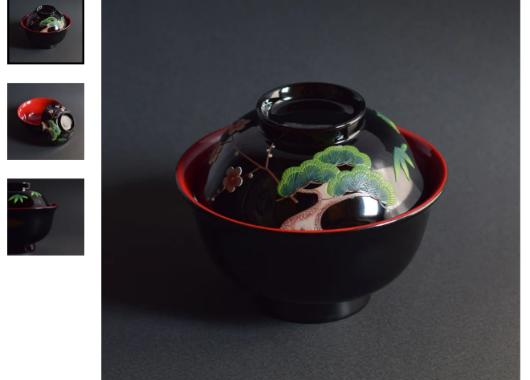
Clam-shaped soup bowl

Product features
琉球漆器の歴史は古く、中国との貿易が盛んであった琉球王国時代14~15世紀頃中国から伝わったとされております。
沖縄独自の技法「堆錦」が加飾された「吸物椀」は、琉球独特の朱塗や加飾の美しさに加えて漆器の熱伝導率が低いという機能性を持ち合わせておりますので、あたたかいものは冷めにくく、なめらかでしっとりとした口当たりが特徴です。
[English]
Ryukyu lacquerware has a long history, and is said to have been introduced from China around the 14th or 15th century during the Ryukyu Kingdom era, when trade with China was thriving.
The soup bowls, decorated using the unique Okinawan technique of "tsuikin," not only boast the beauty of the Ryukyu's distinctive vermilion lacquer and decorations, but also the functionality of lacquerware, which has low thermal conductivity. This means that hot food does not cool down easily and has a smooth, moist feel in the mouth.
[Français]
La laque Ryukyu possède une longue histoire et aurait été introduite de Chine vers le XIVe ou XVe siècle, à l'époque du royaume de Ryukyu, période où le commerce avec la Chine était florissant.
Les bols à soupe, décorés selon la technique unique d'Okinawa du « tsuikin », té moignent non seulement de la beauté de la laque vermillon et des décors caracté ristiques de Ryukyu, mais aussi des propriétés fonctionnelles de la laque, à faible conductivité thermique. Ainsi, les aliments chauds conservent leur chaleur et restent agr éablement moelleux en bouche.
沖縄独自の技法「堆錦」が加飾された「吸物椀」は、琉球独特の朱塗や加飾の美しさに加えて漆器の熱伝導率が低いという機能性を持ち合わせておりますので、あたたかいものは冷めにくく、なめらかでしっとりとした口当たりが特徴です。
[English]
Ryukyu lacquerware has a long history, and is said to have been introduced from China around the 14th or 15th century during the Ryukyu Kingdom era, when trade with China was thriving.
The soup bowls, decorated using the unique Okinawan technique of "tsuikin," not only boast the beauty of the Ryukyu's distinctive vermilion lacquer and decorations, but also the functionality of lacquerware, which has low thermal conductivity. This means that hot food does not cool down easily and has a smooth, moist feel in the mouth.
[Français]
La laque Ryukyu possède une longue histoire et aurait été introduite de Chine vers le XIVe ou XVe siècle, à l'époque du royaume de Ryukyu, période où le commerce avec la Chine était florissant.
Les bols à soupe, décorés selon la technique unique d'Okinawa du « tsuikin », té moignent non seulement de la beauté de la laque vermillon et des décors caracté ristiques de Ryukyu, mais aussi des propriétés fonctionnelles de la laque, à faible conductivité thermique. Ainsi, les aliments chauds conservent leur chaleur et restent agr éablement moelleux en bouche.
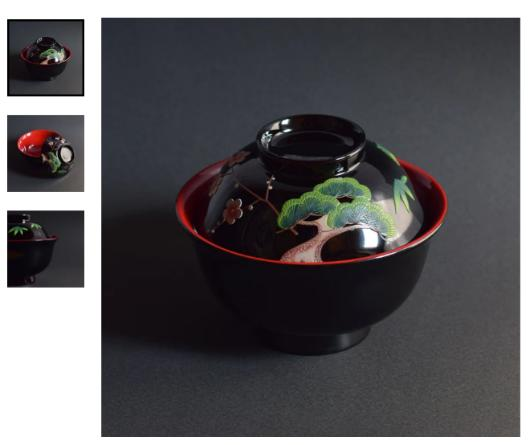
Product image
Product specifications
Product name | 吸物椀 蛤型 Clam-shaped soup bowl Bol à soupe en forme de palourde |
|---|---|
Country of origin | |
Description | (使用上の注意事項)/ Notes ・直射日光は避けてください ・電子レンジ、食器洗浄乾燥機、冷蔵庫のご使用はお控えください ・床など硬い場所への落下や衝撃は漆器の破損につながりますのでお気を付けください ・洗浄の際、シンクでの破損も多くみられますのでやさしくお取扱いいただきますようお願い申し上げます ・お食事を入れる際には75度以上の高温は避けていただけると幸いです。(塗膜の変色など劣化する場合があります)ひとが飲めるあたたかい温度、冷たい温度を推奨します。 ・漆器を洗浄した後はすみやかに綿の布で拭き上げて水気がなくなってからおしまいくださいませ。中性洗剤と柔らかなスポンジが使用可能です。 [English] - Avoid direct sunlight. - Avoid using in the microwave, dishwasher, or refrigerator. - Dropping or impacting lacquerware on hard surfaces like the floor can cause damage. - Please handle with care when washing, as damage to lacquerware in the sink is common. - When serving food, please avoid temperatures above 75°C. (This may cause discoloration and deterioration of the coating.) We recommend serving water at a temperature warm or cold enough for humans to drink. - After cleaning your lacquerware, promptly wipe it with a cotton cloth and allow it to dry before storing it away. You can use a mild detergent and a soft sponge. [Français] - Évitez l'exposition directe au soleil. - Évitez d'utiliser au micro-ondes, au lave-vaisselle ou au réfrigérateur. - Les chutes ou les chocs sur des surfaces dures comme le sol peuvent endommager la vaisselle laquée. - Manipulez avec précaution lors du lavage, car il est fréquent d'endommager la vaisselle laquée dans l'évier. - Pour servir des aliments, évitez les températures supérieures à 75 °C (cela pourrait entraîner une décoloration et une dété rioration du revêtement). Nous recommandons de servir l'eau à une température agréable à boire. - Après avoir nettoyé votre vaisselle laquée, essuyez-la immédiatement avec un chiffon en coton et laissez-la sécher avant de la ranger. Vous pouvez utiliser un détergent doux et une éponge douce. |
Shipping details | |
Content | 1 |
Date of manufacture | |
Shelf life (number of days) | |
Storage condition | |
Wholesale price in Japan | |
Weight per pcs | |
Size per pcs(L*W*H) | W122×D122×H95mm |
Weight per case | |
Package Size(L*W*H) | |
Ingredients | |
Allergy | |
Company name | 株式会社角萬漆器 KAKUMANSHIKKI Co., Ltd. |
JAN code | |
Case ITF code |
Nutrition Facts(100g)
Calories | |
|---|---|
Protein | |
Fat | |
Carbohydrate | |
Sodium | |
Iron | |
Salt |